
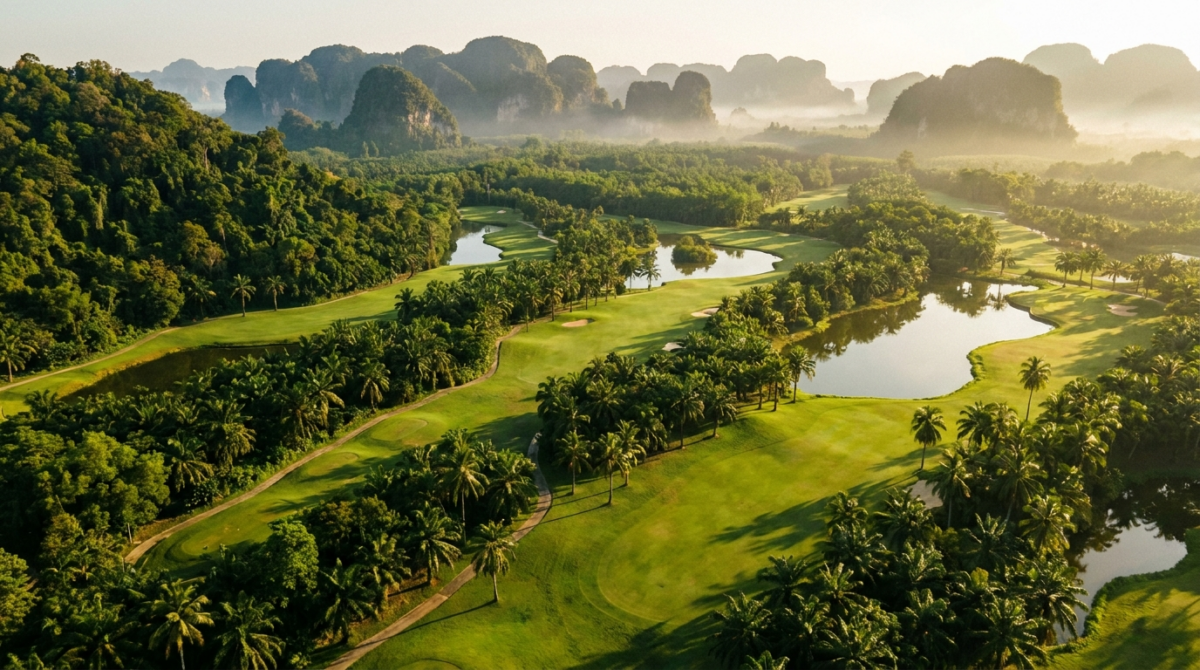
Thailand has quietly become one of the great golf destinations on Earth — a place where a top-tier championship course, a professional caddie, and a post-round Chang beer cost a fraction of what you would pay in Europe, Japan, or the United States. In a single week you can play a Gil Hanse links tribute outside Bangkok in the morning, cool off on the Gulf coast at Pattaya by the weekend, and finish among the pine-scented mountains of the north — all without ever changing currency or renting a car. This is the GongGolf Editorial pillar guide: everything you actually need to know before you book, from where to play and when, to what a round really costs and how golf itself works differently here.
Consider this page your home base. From here we link down to detailed city hubs and individual course write-ups, so you can go as deep as you like on any region. Let’s start with the obvious question.
Why Thailand Is a Top Golf Destination
Three things make Thailand special, and they compound.
Density and choice. The concentration of courses around the major cities is extraordinary. There are more than 50 golf courses within roughly an hour of central Bangkok alone, and Pattaya adds over 20 more within a short radius. You can base yourself in one hotel and rotate through a dozen quality layouts without ever repeating one. That density is rare anywhere in the world and almost unheard of at Thailand’s price point.
Genuine pedigree. This is not a collection of resort filler. Thailand has hosted world-class professional golf for decades — the Old Course at Siam Country Club near Pattaya has staged the Honda LPGA Thailand every year since 2007, and courses here appear on serious “best of Asia” rankings. The design talent that has worked in Thailand includes American architect Denis Griffiths (Thai Country Club, built to USGA specifications) and Gil Hanse, whose Ballyshear Golf Links is a rare authentic links-style course inspired by the lost Lido on Long Island. When Tiger Woods won the 1997 Asian Honda Classic, he did it at Thai Country Club.
The caddie culture and the value. Every course in Thailand provides a caddie, and the experience of playing with a knowledgeable local caddie who reads grain-heavy greens, tracks your ball, and keeps you hydrated fundamentally changes the round for the better. Combine that with green fees that undercut most Western destinations, warm-water beaches, celebrated food, and famously easy hospitality, and you have a golf trip that works as a full holiday for players and non-players alike.
The Main Golf Regions
Thailand’s golf is clustered in five destinations. Each has a distinct character; picking the right base is the single biggest decision of your trip.
Bangkok
The capital is the country’s golf epicenter, ringed by roughly 50-plus courses within about an hour of the city — including USGA-spec championship layouts and Ballyshear, Thailand’s standout links-style course. Bangkok pairs top-tier golf with world-class dining, hotels, and nightlife, making it the natural landing point and hub for most trips. See our Bangkok golf guide for the full breakdown.
Pattaya
A 90-minute-to-two-hour drive southeast of Bangkok, Pattaya packs more than 20 courses into a compact coastal area, headlined by the multiple Siam Country Club layouts. It’s the most efficient golf-per-day base in the country and an easy add-on to a Bangkok trip. See our Pattaya golf guide for details.
Hua Hin
The original Thai golf resort town, on the Gulf coast southwest of Bangkok, Hua Hin trades big-city bustle for a calmer, more upscale feel. It’s home to celebrated courses such as Black Mountain Golf Club, which has hosted Asian Tour events and earned international recognition. The playable window here is unusually long, running roughly November through May.
Phuket
Thailand’s largest island offers several championship courses set against tropical scenery and beaches — Blue Canyon Country Club, with two 18-hole championship courses, is the marquee name. Phuket suits golfers who want a full beach-resort holiday wrapped around their rounds, though it’s a flight rather than a drive from Bangkok.
Chiang Mai
The cultural capital of the north swaps coastline for mountains, cooler air, and scenic elevated fairways. Chiang Mai Highlands Golf and Spa Resort — a 27-hole layout that opened its first 18 holes in 2005 — is the standout. December through February mornings here can be genuinely crisp, occasionally cool enough for a light jacket on the first tee, which is part of the region’s appeal.
Best Time to Play: Season and Weather
Thailand is playable year-round, but conditions vary a lot by season. There are three broad periods.
Cool, dry season (roughly November to February) — the peak. This is widely considered the best time to play golf in Thailand. Humidity drops, rainfall is minimal, and daytime temperatures are at their most comfortable — often around the low-to-high 20s Celsius (70s to mid-80s Fahrenheit), with pleasantly cool mornings. It is also high season, so expect busier tee sheets and higher rates; book courses and tee times in advance.
Hot season (roughly March to May). Temperatures climb and the middle of the day gets genuinely hot. Golf is still very doable — many regional windows, such as Hua Hin’s, extend into May — but you’ll want early tee times and a serious hydration plan. Our guide to golf fitness, power, and staying loose is worth a read before a hot-weather trip, as heat and dehydration sap both distance and concentration fast.
Green (rainy) season (roughly June to October). The monsoon brings higher humidity and rain, but it’s rarely all-day rain — showers often arrive as short, heavy afternoon bursts. Courses are lush and green, crowds thin out, and green fees can be at their lowest. With flexible scheduling and morning tee times, the green season can be excellent value.
The single smartest habit in any month is to tee off early. Starting before roughly 9:30 a.m. means you finish before the worst of the midday heat and before typical afternoon showers arrive — this holds true across every region and every season.
| Season | Months (approx.) | Conditions | Notes |
|---|---|---|---|
| Cool & dry (peak) | Nov–Feb | Comfortable, low humidity, minimal rain | Best conditions; busiest and priciest — book ahead |
| Hot | Mar–May | Hot midday, mostly dry | Play early; hydrate; some coastal windows run into May |
| Green / rainy | Jun–Oct | Humid, short heavy afternoon showers | Lush courses, thinner crowds, best value |
What a Round Costs
Green fees in Thailand span a wide range, so it helps to think in tiers rather than a single number. As a broad guide, a round of 18 holes commonly falls somewhere between about 1,500 and 6,500 THB, with value public courses at the lower end and high-end resort courses running higher again. Weekend and public-holiday rates are typically several hundred baht above weekday rates — a course charging a mid-range fee on a Saturday may be dramatically cheaper on a Tuesday or Wednesday. All figures here are indicative ranges; always verify the current rate at the operator or course website before you book, as pricing shifts by season, day, and package.
Two costs sit on top of the green fee and are easy to overlook when budgeting:
- Caddie fee: mandatory and typically in the region of 400–600 THB, sometimes bundled into the green fee and sometimes separate (verify at operator site).
- Caddie tip: a customary gratuity paid directly to your caddie after the round — commonly around 400 THB or more per 18 holes, more for excellent service or at premium courses. This is separate from the caddie fee.
- Buggy / cart: often optional at some courses and effectively mandatory at premium resort courses to protect the turf. Where required it may or may not be included in the advertised green fee (verify at operator site).
Add it up and a realistic all-in figure per round should include the green fee, the caddie fee, a caddie tip, and possibly a cart — budgeting for all of these avoids surprises at check-in.
How Golf Works in Thailand
A few things differ from what many visitors are used to. None are difficult; knowing them in advance just makes the experience smoother.
Caddies Are Mandatory — and Excellent
Every golf course in Thailand provides caddies, and taking one is not optional. This is rooted in the industry’s history — as farmland was converted to courses, providing caddie employment became standard practice. In practice it’s a highlight: Thai caddies do far more than carry the bag. They give yardages, read the notoriously grain-influenced greens, clean clubs, track wayward shots, and keep you hydrated and shaded through the heat. Treat your caddie as a partner for the round and tip them well at the end.
Buggies and Walking
Cart (buggy) availability and rules vary by course. At many premier resort courses a cart is compulsory to protect the grass. For insurance reasons, it’s common that only the caddie is permitted to drive the cart, not the golfer — so don’t be surprised when your caddie takes the wheel.
Dress Code
Thai courses maintain a consistent smart-casual standard. For men: a collared (polo-style) shirt, tailored shorts or trousers, and golf shoes with soft spikes. For women: a golf-appropriate top with sleeves or a collar, and a golf skirt, shorts, or trousers. Across the board, no denim, no sleeveless shirts without a collar, and no beachwear on the course or in the clubhouse. Pack accordingly.
Etiquette and On-Course Manners
General golf etiquette applies as it does anywhere — pace of play, care of the course, and respect for playing partners — with the added dimension of working courteously with your caddie. If you’re newer to the game or want a refresher before your trip, our beginner’s guide to golf-course etiquette covers the fundamentals that travel well to any country.
Getting Around and Trip Logistics
Thailand is an easy country to move around for golf, and a little planning goes a long way.
Entry requirements. Many nationalities can enter Thailand under a visa-exemption scheme, but the rules and the length of permitted stay have been in flux recently, so always confirm the current visa policy for your nationality with an official Thai government or embassy source before you travel — do not rely on older articles or forum posts, as the permitted duration has changed. Entry conditions can also include proof of onward travel and sufficient funds.
Airports. Bangkok is served by two major airports — Suvarnabhumi (BKK) and Don Mueang (DMK) — and the other regions have their own international gateways, including Chiang Mai (CNX) and Phuket (HKT). That means you can fly directly into most golf regions or use Bangkok as a hub and connect onward by domestic flight.
Getting between regions. Pattaya is the easy add-on to a Bangkok trip: it’s roughly 150 km southeast, typically about 1.5 to 2 hours by private car or van via the motorway depending on traffic and pickup point. For golf groups, a private car or van transfer is usually the best option — door-to-door pickup, room for golf bags without cramping passengers, and transparent all-in pricing. Ride-hailing apps and metered taxis are also widely available. Leaving early in the morning helps you dodge Bangkok’s congestion and get more out of your day. For regions like Phuket and Chiang Mai, a short domestic flight is usually the sensible move rather than a long overland drive.
On-course transport. Once you’re at a course, most clubs can arrange transfers, and many golf-travel operators bundle transport with tee times as part of a package — worth comparing against arranging your own.
Plan Your Trip
Ready to start building an itinerary? Use these GongGolf resources as your next steps.
- Choose your base. Start with our city hubs: the Bangkok golf guide for the widest choice and easiest arrival, or the Pattaya golf guide for concentrated coastal golf. Many trips combine both.
- Pick your courses. Three standouts to anchor a Bangkok–Pattaya trip:
- Thai Country Club — the Denis Griffiths–designed championship venue east of Bangkok where Tiger Woods won the 1997 Asian Honda Classic.
- Ballyshear Golf Links — Gil Hanse’s Lido-inspired, links-style course, a genuine rarity in tropical Asia, just east of Bangkok near Suvarnabhumi Airport.
- Siam Country Club (Old Course) — the long-running Honda LPGA Thailand host near Pattaya, masterfully renovated in 2007.
- Time it right. Aim for the cool, dry window (roughly November to February) for the best conditions — and book early, because it’s also the busiest season.
- Prepare your game and body. Heat is the hidden opponent here. Our golf fitness and hydration guide will help you hold up over multiple rounds in the tropics, and brushing up on course etiquette ensures you’ll fit right in.
Thailand rewards golfers who plan a little and then relax into the pace of the place. Get the season, the base, and the basics right, and the rest — the caddies, the courses, the value, the food — takes care of itself.
GongGolf Editorial. Prices and entry rules change frequently; always verify current green fees, cart and caddie policies at each course’s official site and confirm visa requirements with an official Thai government source before booking.