
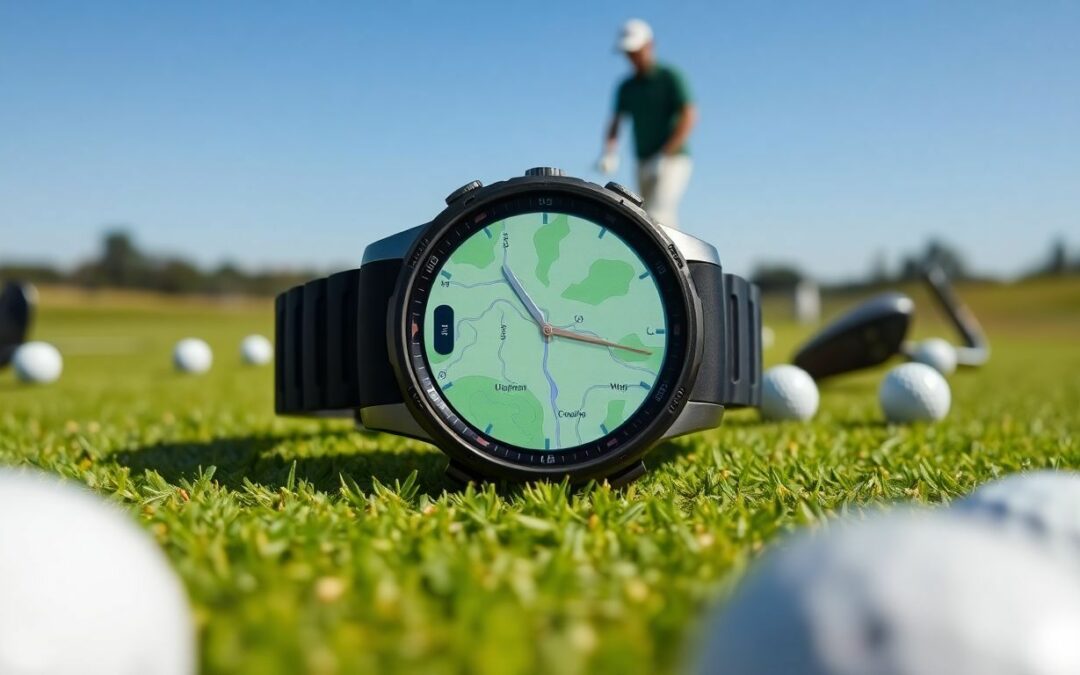
The best golf GPS for you depends less on brand than on how you play: walkers do best with a GPS watch, players who want an exact number to the flag need a laser rangefinder, cart golfers get more from a speaker or big-screen handheld, and anyone unsure should start with a free app. This guide covers all six device types with picks verified as current product lines in 2026 — including which ones charge a subscription and which never will — so you can match the technology to your game instead of buying the first gadget you see.
Key Takeaways
- Pick the device type first: watches for walkers, laser rangefinders for exact pin numbers, handhelds for simplicity and battery life, speakers for cart golf, apps for a free start, GPS trolleys if you already want an electric caddie.
- Subscriptions are the hidden cost. Garmin, Shot Scope, Bushnell, Blue Tees and Voice Caddie devices work without one; SkyCaddie needs a membership for map updates and Arccos requires one after the first year.
- The Garmin Approach G12 remains the cleanest no-subscription buy: 42,000+ preloaded courses with free lifetime updates and about 30 hours of GPS battery.
- Several 2024-era models have been replaced: the TAG Heuer Calibre E4 gave way to the Calibre E5 Golf Edition, Bushnell’s Phantom 2 to the Phantom 3 Slope, Garmin’s G80 handheld to the new G82, and PowaKaddy’s RX1 GPS to the RX12 GPS.
- Laser rangefinders are accurate to about a yard; GPS units trade a few yards of precision for full-hole context like hazards, green shape and layup targets.
The Device Types at a Glance
Six ways to get yardages — what this guide covers in each class and why you’d pick it.
| Type | Picks in this guide | Why this type |
|---|---|---|
| GPS watches | Garmin S70, SkyCaddie LX5, TAG Heuer Calibre E5, Shot Scope X5, Bushnell iON Elite | Lightweight and wearable; yardages on the wrist |
| Rangefinders | Garmin Z82, Shot Scope PRO LX+, Voice Caddie SL3 Active (hybrid) | Precise distances to the pin, with slope options |
| Handhelds | Garmin G82, SkyCaddie SX550, Bushnell Phantom 3, Garmin G12 | Larger screens and green views; G82 adds a launch monitor |
| GPS speakers | Bushnell Wingman VIEW, Blue Tees Player+, Voice Caddie VC4 | Music plus distances, stats and course maps |
| GPS apps | Arccos Caddie, Hole19, VPAR | Phone-based yardages, stats and live leaderboards |
| GPS trolleys | PowaKaddy RX12 GPS, Motocaddy M7 GPS | Electric trolley with yardages and remote control |
Every device below gets its own breakdown, followed by the features worth weighing.
Which Type Fits Which Golfer
A quick routing before the individual picks. Walkers who glance at yardages between shots want a watch — nothing to dig out of a pocket. Golfers who play to precise numbers want a laser, with roughly one-yard accuracy GPS cannot match. Handhelds offer bigger maps, longer batteries and lower prices than premium watches. Speakers suit cart groups that want music anyway, apps cost nothing to try, and GPS trolleys are electric caddies first with a yardage screen thrown in.
Best Golf GPS Watches
Golf GPS watches put front, middle and back yardages on your wrist and increasingly double as everyday smartwatches. All five picks here are current 2026 models.
Garmin Approach S70 GPS Watch
The Approach S70 is still Garmin’s flagship golf watch — the newer S44 and S50 released in 2025 slot in below it, not above. It carries more than 43,000 preloaded full-color course maps on a bright AMOLED touchscreen (1.2" on the 42 mm model, 1.4" on the 47 mm), and Garmin quotes up to 20 hours of GPS battery for the larger version. The Virtual Caddie suggests clubs based on your real distances and the wind, and off the course it behaves like a full Garmin smartwatch with heart rate, pay and music features.
Core yardages and maps need no subscription; only extras such as green contour data sit behind the optional Garmin Golf membership. Expect to pay roughly $650–$700 (verify) — this is the premium end of the category.
SkyCaddie LX5 GPS Watch
The LX5 is SkyCaddie’s argument that map quality beats everything else. Its 35,000+ courses are ground-verified — mapped by people walking the course rather than traced from aerial photos — and the IntelliGreen view rotates the green to your angle of approach. The 1.39" color touchscreen is one of the biggest and brightest on any golf watch, the case weighs about 65 grams, and battery life covers roughly two rounds.
The honest caveats: this is now an aging model with no announced successor, the standard version drifts in and out of stock, and SkyCaddie’s system is membership-based — the watch ships with a prepaid membership period, after which you pay an annual plan to keep maps updated. Factor that into any price comparison.
TAG Heuer Connected Calibre E5 Golf Edition
TAG Heuer has replaced the Calibre E4 Golf Edition that used to occupy this slot: the current model is the Connected Calibre E5 Golf Edition, a 45 mm titanium watch running TAG’s own operating system instead of Wear OS. Golf press coverage of the launch highlights dual-band GNSS with a GPS lock around three times faster than the previous generation, more than 40,000 downloadable courses, a redesigned full-hole map view and improved automatic shot detection. A TaylorMade collaboration edition followed in 2026.
This is a luxury purchase — around $2,400 (verify) — and you are paying for the watchmaking as much as the golf features. For pure on-course function, the Garmin S70 does more for a third of the money; the TAG is for golfers who want one premium watch for everything.
Shot Scope X5 GPS Watch
The X5 remains Shot Scope’s premium watch, and its pitch is unique in this group: automatic shot tracking is built in. Sixteen lightweight tags screw into your grips, the watch records every shot, and the free dashboard turns your rounds into 100+ tour-style statistics including strokes gained — data that genuinely supports better on-course decision making. It carries 36,000+ preloaded courses on a color touchscreen and runs two or more rounds per charge.
Shot Scope explicitly guarantees no subscription — software, maps and stats are free for life — which makes the roughly $200–$300 price (verify) one of the strongest value propositions in golf tech.
Bushnell iON Elite GPS Watch
Bushnell’s flagship watch is the simplest of the five, and that is its appeal. It brings the company’s patented slope-compensated distances to the wrist — with a toggle to switch slope off for tournament play — plus dynamic green mapping with a movable pin, 38,000+ preloaded courses across 30+ countries, and up to six hazard distances per hole. At 38 grams it is the lightest watch here, the 1.28" color touchscreen is easy to read, and Bushnell quotes 12+ hours of GPS battery, good for two-plus rounds.
There is no subscription and course updates are free through the Bushnell Golf app. Street prices typically sit under $250 (verify). No shot tracking or smartwatch extras — just clean yardages.
Best Golf Rangefinders
Laser rangefinders answer one question better than any GPS: exactly how far is the flag. The three picks here all add GPS or tracking features on top of the laser.
Garmin Approach Z82 Golf Rangefinder
The Garmin Approach Z82 is still the most complete laser-GPS hybrid on the market. Look through the viewfinder and you see the laser number plus a 2D map of the hole overlaid at the edge of the view, with front and back green distances from more than 41,000 preloaded courses. Garmin claims accuracy within 10 inches of the flag, supported by image stabilization and a vibration pulse when the laser locks on. Hole detection is automatic, and a tournament mode disables the non-conforming aids when needed.
It sits at the premium end of the category, typically around $550–$600 (verify), with no subscription attached. If you only want the laser without the GPS overlay, Garmin’s simpler Z30 costs considerably less.
Shot Scope PRO LX+ Laser Rangefinder
The PRO LX+, now in its second generation, is really three devices: a 7x-magnification laser rated to 900 yards with accuracy inside a yard, a detachable H4 GPS handheld that rides on the side of the unit showing front, middle and back yardages, and Shot Scope’s performance-tracking system. Adaptive slope adjusts for elevation and toggles off for competition. Shot Scope’s current rangefinder range also includes the cheaper Pro L2 and the fast-firing Pro ZR if you want the laser alone.
As with the X5 watch, everything is subscription-free for life. The full LX+ bundle sits around $350–$400 (verify), which undercuts buying a comparable laser and GPS separately.
Voice Caddie SL3 Active Hybrid GPS Laser Rangefinder
Voice Caddie’s hybrid now comes in two current forms: the standard SL3 and the newer SL3 Active variant sold alongside it. Either way this is the most screen-heavy rangefinder available — alongside a 6x-magnification laser rated to 1,000 yards with accuracy inside a yard, a touchscreen shows course layout, green undulation detail and putt-view information, with GPS assisting the laser’s pin tracer for a stable lock. Slope compensation is built in, battery life is quoted at 20 hours in GPS mode, and retail listings bill it as an official rangefinder of the LPGA.
It is a lot of technology in one unit, and the price reflects that — around $500–$600 (verify), competing with the Z82 at the premium end. Golfers who just want a number to the flag will find simpler lasers do that job for far less.
Best Handheld Golf GPS Devices
Handhelds trade wearability for bigger screens, longer batteries and lower prices. This group runs from a launch-monitor hybrid to the cheapest reliable GPS in the guide.
Garmin Approach G82 Golf GPS & Launch Monitor
Garmin introduced the Approach G82 in January 2026, and reviewers and Garmin’s own lineup treat it as the replacement for the long-serving G80. The idea is unchanged and still unique in golf: a handheld GPS with a built-in radar launch monitor that measures club head speed, ball speed, smash factor, tempo and estimated distance, so one pocketable unit covers both the round and the range session. The G82 upgrades to a 5" high-resolution touchscreen and adds putting metrics. It launched at around $600 (verify); remaining G80 stock at retailers is the value route to the same core GPS-plus-radar concept while it lasts.
SkyCaddie SX550 Handheld Golf GPS
The SX550 is still SkyCaddie’s flagship handheld, built around a 5.5" full-HD touchscreen and the same ground-verified mapping of 35,000+ courses that defines the brand. For golfers who care about exact green shapes, verified hazard positions and pin-position detail, reviewers consistently rate SkyCaddie’s maps as the benchmark. Like the LX5 watch, it comes with a prepaid membership period — typically a year — after which an annual SkyGolf plan is required to keep course data current, so treat the membership as part of the real cost.
Bushnell Phantom 3 Slope Handheld GPS
Bushnell has discontinued the Phantom 2 that previously held this spot — its own product page says so — and the current model is the Phantom 3 Slope, launched in mid-2024. The headline changes are a touchscreen (the Phantom 2 made you scroll with side buttons), patented slope-compensated distances at a budget price for the first time in a Bushnell handheld, automatic course and hole recognition and USB-C charging. It carries 38,000+ preloaded courses, and the deliberately simple display is why Bushnell quotes 18+ hours of battery. There are no subscription fees, and it typically sells for around $150–$170 (verify).
For golfers who want dependable yardages with the least money and fuss, this is the pick.
Garmin Approach G12 GPS
The G12 is the answer to one of the most common questions golfers ask about this category: which golf GPS has no subscription, ever. The clip-on unit ships with 42,000+ preloaded courses and free lifetime course updates — Garmin pushes refreshed maps roughly three times a year at no charge, with no premium tier required for any on-course function. It weighs under an ounce, clips to a belt, bag or cap, is IPX7 water-rated, and runs up to about 30 hours of GPS per charge — several rounds between top-ups.
The trade-off is the display: a small monochrome screen without touch. You get numbers, not maps. As a pure yardage tool with zero ongoing costs, nothing in this guide is simpler to own.
Best Golf GPS Speakers
GPS speakers ride on the cart, play your music and call out distances. Two of these are true music speakers; the third is a talking GPS worth knowing about.
Bushnell Wingman VIEW GPS Speaker
The Wingman VIEW is the version of Bushnell’s popular golf speaker with a screen: an LCD readout shows GPS distances and track info, while audible callouts cover front, center and back plus up to six hazard distances per hole from 36,000+ preloaded courses. The BITE magnet clamps it to a cart bar, battery life runs about 10 hours, and GPS comes through the free Bushnell Golf app with no subscription. If you do not need the screen, the Wingman 2 sibling offers longer 14-hour battery, USB-C charging, a built-in mic and an integrated magnetic remote for less money.
Blue Tees Player+ GPS Speaker
Blue Tees has moved on from the original Player speaker this guide once listed — its GPS models are now the Player+ and the newer Player Pro. The Player+ is the established pick: a magnetic, IPX7-waterproof speaker with a 3" touchscreen showing front, middle and back yardages and hazard distances across 40,000+ courses via the free Blue Tees app, plus 10+ hours of battery and a built-in power bank for your phone. The 2026 Player Pro adds IP67 dust protection, multi-speaker pairing and audible club suggestions for those who want the newest version. Neither requires a subscription.
Voice Caddie VC4 Voice Golf GPS
The VC4 is the odd one out in this group — it talks, but it does not play music. The tiny clip-on unit (under 30 grams, small enough for a cap brim) announces distances to the front, middle and back of the green at the press of a button, with Auto Slope adjusting the numbers for elevation. It recognizes the course and hole automatically from a database of 40,000+ courses, runs up to 54 holes per charge, and course updates are free. For golfers who want yardages without ever looking at a screen, it is the cheapest hands-free option going.
Best Golf GPS Apps
Your phone can do most of what dedicated hardware does — sometimes free, sometimes on the steepest subscription in this guide.
Arccos Caddie Shot-Tracking System
Arccos remains the most complete shot-tracking system in golf, and it has evolved since this guide first covered it. The current setup pairs screw-in smart sensors on every club with Arccos Air — the wearable that grew out of the Link Pro — so rounds are recorded fully phone-free. The payoff is strokes-gained analytics across every part of your game, GPS with plays-like distances, and an AI caddie that recommends clubs from your real performance data.
Be clear-eyed about the cost model: a year of membership is bundled with new sensor sets, but after that Arccos requires an ongoing membership — currently in the region of $200 per year billed annually (verify). This is a subscription product first and hardware second.
Hole19 Golf GPS App
Hole19 is the strongest free starting point in golf GPS. The free tier covers GPS yardages, digital scorecards and basic statistics across 42,000+ courses in over 200 countries, and its LivePlay feature runs live leaderboards for group rounds. The optional Premium tier adds plays-like distances, club recommendations, shot tracking and smartwatch scoring for roughly the price of a dozen premium balls per year (verify regional pricing). Download it free, play a few rounds, and you will know whether dedicated GPS hardware is worth buying at all.
VPAR Golf GPS App
VPAR’s specialty is competition. The core app is free and combines GPS yardages and course maps on tens of thousands of courses (VPAR says 40,000+, app stores 30,000+) with real-time leaderboards supporting strokeplay, Stableford and matchplay — which is why golf societies and trip organizers gravitate to it. The same company runs live scoring for professional and corporate events, and that tournament DNA shows in how well the leaderboards work. For casual golfers it is less of a stats engine than Hole19 or Arccos, but for a group that wants a live scoreboard running all day, it is the pick.
Best Golf GPS Trolleys
GPS trolleys are electric caddies first — you buy one to stop carrying — with a yardage screen built into the handle so you do not need a second device.
PowaKaddy RX12 GPS Electric Trolley
PowaKaddy has revamped its remote range since this guide last looked: the RX1 GPS is gone from the current catalog, replaced by the RX12 GPS. PowaKaddy calls it the world’s first touchscreen remote-controlled GPS trolley, and the 5" HD portrait screen — the largest in the category — shows a full-hole view from 40,000+ preloaded courses with no subscription fees. Twin 230 W motors, Slope Traverse Assist to hold a line across side slopes, and a slimline remote handset complete the package. Pricing sits firmly in premium four-figure territory (verify), so this is for golfers already committed to an electric trolley.
Motocaddy M7 GPS Remote Electric Trolley
Motocaddy’s flagship was overhauled for 2026, and the current M7 GPS Remote is a genuine step up in GPS quality: a dual-antenna module rated to sub-3-meter accuracy even under tree cover, feeding a 3.5" touchscreen with 2D and 3D maps, hole flyovers and a movable target for planning layups. Mapping covers 40,000+ courses with free lifetime access. The USB-C rechargeable remote steers the trolley from around 100 meters, twin 230 W motors handle hills with automatic downhill control, and the aluminium chassis folds compactly at 14.8 kg. Like the PowaKaddy, it is a premium purchase north of $2,000 (verify).
Features to Consider When Choosing a Golf GPS Device
Four factors separate a device you use every round from one that stays in the garage.
Accuracy and Course Mapping
All GPS devices are accurate enough to pick a club — typically within a few yards — but map quality varies more than accuracy does. SkyCaddie’s ground-verified maps are the benchmark for green shapes and hazard positions; Garmin’s strength is coverage and full-color detail across 40,000+ courses. Lasers are the accuracy ceiling: around one yard, straight to the flag. The practical question is what you want to see — a number (laser, G12, VC4), a hole map (watches, handhelds), or both (Z82, SL3 Active).
Battery Life and Portability
Watches generally cover one to two rounds per charge, with the Garmin S70’s 20-hour GPS mode the standout. Handhelds go furthest — the G12’s roughly 30 hours and the Phantom 3’s 18+ hours both beat any watch. Speakers run about 10 to 14 hours. Weight matters most on the wrist: the 38-gram Bushnell iON Elite and the sub-30-gram clip-on VC4 disappear during the swing, while trolley screens weigh nothing on you at all.
Subscription vs. Non-Subscription Options
This is the cost most buyers miss, so here is the honest map of it. Devices with no subscription for any core function: every Garmin here (S70, Z82, G82, G12 — free lifetime course updates), both Shot Scope products (subscription-free for life, guaranteed), all Bushnell devices, Blue Tees speakers, Voice Caddie units, and both GPS trolleys. Devices that require ongoing payment: SkyCaddie (LX5 and SX550 ship with prepaid membership periods, then an annual plan keeps maps updated) and Arccos (membership required after the bundled first year). Freemium: Hole19 and VPAR have genuinely useful free tiers with optional paid upgrades, and Garmin’s optional Golf membership adds extras like green contours without ever being required.
Ease of Use and Display Quality
A device you can read at a glance in bright sun beats a prettier one you have to shade with your hand. AMOLED and HD touchscreens (S70, LX5, SX550, RX12) are the most legible and the most power-hungry; transflective and monochrome displays (Phantom 3, G12) look plain but actually improve in direct sunlight and run for days. Audio-first devices — the Wingman VIEW’s callouts and the VC4’s voice — skip the reading problem entirely. Waterproofing worth having starts at IPX7, which most devices here meet.
How This Guide Was Put Together
We have not lab-tested these devices ourselves, and we will not pretend otherwise. Every pick was checked against the manufacturer’s current 2026 catalog to confirm it is still a live product line — which is why several models from earlier versions of this guide have been swapped for their successors — and every specification cited comes from the maker’s published pages or launch coverage in the golf press. Where reviewers’ hands-on findings add context, we attribute them. Where a claim could not be verified, it was cut. Prices are stated as bands because street prices move constantly; always verify before buying.
Golf GPS FAQs
Do golf GPS devices require a subscription?
Most do not. Garmin, Shot Scope, Bushnell, Blue Tees, Voice Caddie, PowaKaddy and Motocaddy all provide core yardages and free course updates with no ongoing fees. The exceptions are SkyCaddie, whose ground-verified maps require an annual membership after the prepaid period bundled with the device, and Arccos, which requires a membership after the first year included with new sensors. Apps like Hole19 and VPAR are free with optional premium tiers.
Which golf GPS has no subscription at all?
The Garmin Approach G12 is the cleanest example: 42,000+ preloaded courses, free lifetime course updates, and no premium tier gating any on-course function. Shot Scope goes furthest as a brand, explicitly guaranteeing that its watches, rangefinders and stats platform stay subscription-free for life.
Are golf GPS devices better than rangefinders?
They answer different questions. A laser rangefinder gives the exact distance to the flag — accurate to about a yard — which suits golfers who play to precise numbers. GPS gives context: hazards, doglegs, green shape and front/middle/back distances, which matters more on unfamiliar courses. Hybrids like the Garmin Z82 and Voice Caddie SL3 Active do both in one unit, at a price. Many committed golfers eventually carry a laser and wear a GPS watch.
Can golf GPS watches be used off the course?
The premium ones, yes. The Garmin Approach S70 is a full smartwatch with heart-rate tracking, notifications, payments and sport modes, and the TAG Heuer Calibre E5 Golf Edition is a luxury smartwatch first. Golf-focused watches like the Shot Scope X5 and Bushnell iON Elite tell the time and little else off the course — which is also why they cost a fraction as much.
How accurate are golf GPS devices?
Manufacturers typically quote GPS accuracy within a few yards, which is comfortably enough to choose a club. Lasers are tighter — Shot Scope rates the PRO LX+ to within one yard, and Garmin claims the Z82 measures within 10 inches of the flag. The newest GPS hardware is closing the gap: Motocaddy’s 2026 M7 uses a dual-antenna module rated to sub-3-meter accuracy even under tree cover.
Conclusion
Match the type to your game first, then check the subscription question before you pay — it changes the real cost of SkyCaddie and Arccos substantially. Every device in this guide is a current 2026 line, so whichever route fits, you will be buying technology its maker still stands behind.
Tips for Using Your Golf GPS Effectively on the Course
Owning a capable device is only half the battle. A few good habits will help you get the most out of your golf GPS during every round.
- Get familiar with the device before you play. Spend a little time on the range or at home learning the button layout and key features so you are not fumbling on the first tee.
- Charge it fully before heading out. A drained battery mid-round undoes all the planning, so check the charge and expected battery life the night before a long day.
- Pre-load and favorite the courses you play most often. This saves time searching once you arrive and gets you to your yardages faster.
- Use the yardages to commit to a club, not just to know the number. Measure to the front, middle, and back of the green as well as to hazards, then pick your club with confidence.
- Adjust display settings such as brightness and font size for the conditions. A screen tuned for bright sunlight is far easier to read at a glance.
- Keep maps and firmware updated through the companion app so your course data stays accurate over time.
- Clip handheld units securely to a belt, bag, or trolley so they never interfere with your swing.
- Lean on audio distance callouts from GPS speakers when you want hands-free updates while you keep walking.
- Cross-check the occasional yardage against course markers if a reading looks off on unusual terrain, so you learn where your device is most reliable.
Match the Device to How You Play
The right choice depends on your game as much as on the spec sheet. A casual player is often best served by a simple handheld or watch with preloaded courses and an easy setup, while a more competitive golfer benefits from advanced stat tracking, shot analysis, and detailed hazard data. Weigh battery life, accuracy, and ease of use against how often and how seriously you play before deciding.
Practice and Launch Monitor Features
Some handheld units go beyond on-course yardages. The Garmin Approach G80, for example, includes a built-in launch monitor that measures swing speed and ball speed, giving you useful feedback during range sessions or indoor practice as well as on the course. If improving your swing between rounds matters to you, look for a device that doubles as a practice tool.
Part of our golf gear buying guides.