
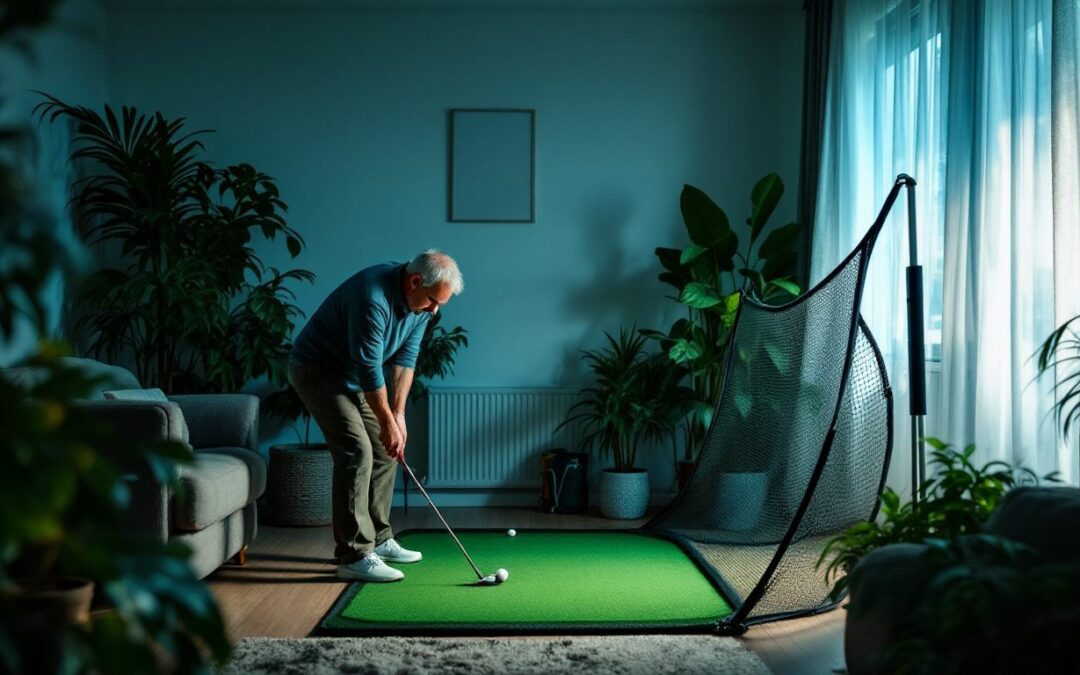
You don’t need a tee time to keep your game sharp. Practicing golf at home is one of the most reliable ways to improve, and it takes far less space and equipment than most players assume. With a few simple tools like a putting mat or a golf net, you can build real skills indoors between rounds.
Below is a practical guide to turning your home into a functional practice space.
Key Takeaways
- Set up a safe practice space using tools like putting mats, golf nets, and simulators. Clear fragile items to prevent accidents.
- Practice drills for putting accuracy, swing improvement, and wedge control with tools such as launch monitors or chipping nets.
- Focus on strength training exercises like planks and wrist stretches to improve stability, flexibility, and grip for better swings.
- Use visualization techniques to plan shots mentally before swinging. Combine this with video recording your practice sessions for analysis.
- Stay motivated in the off-season by setting goals, tracking progress weekly, and using indoor tools like golf simulators or carpet setups.
Setting Up Your Home Golf Practice Space
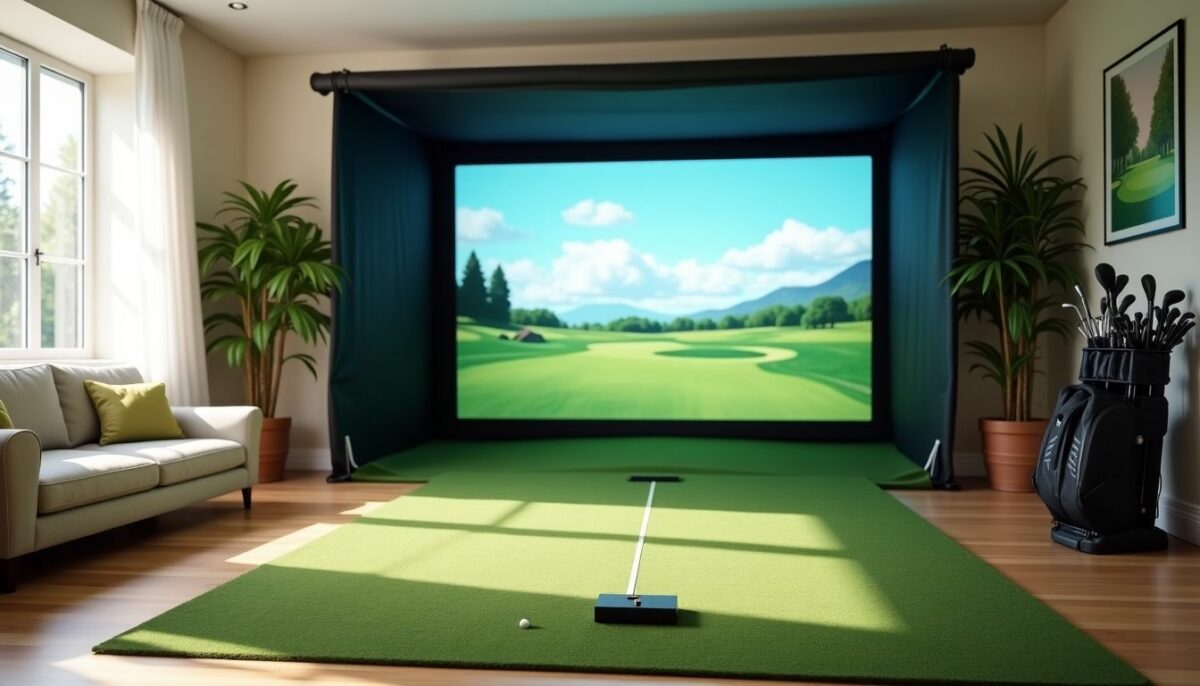
Find a quiet area at home where you can swing freely and focus. Gather tools like putting mats or an indoor golf simulator to make practice effective.
Choosing the right space for practice
A spacious backyard or a secluded side yard works well for outdoor practice. These areas allow full golf swings without the risk of hitting walls or breaking windows. For indoor options, basements, garages, or even small rooms can work if safety rules are followed.
Clear the space of fragile items and pets to avoid accidents.
Putting practice takes minimal room compared to full-swing drills. A clear carpeted area or an indoor putting green is enough for practicing short putts at home. If you are working on longer strokes, pick a spot with enough length to mimic a real putting green’s feel and speed.
Essential equipment for at-home golf training
Practicing golf at home can genuinely improve your skills. Having the right tools makes training effective and keeps sessions productive.
- Golf net
Golf nets allow players to practice full swings safely indoors or in the backyard. They protect walls, windows, and neighbors from stray balls. Prices vary, but basic models start around $50. - Putting mat
These mats are useful for indoor putting drills. They mimic real greens and help with accuracy and speed training. Many options include ball-return features for convenience. - Swing trainer
Tools like swing plates or weighted clubs improve form and strength. These aids guide proper motion and help reduce common mistakes like hooks and slices. - Launch monitor
Launch monitors track data like ball speed, spin rate, and clubhead impact. They provide instant feedback during practice sessions. Models range from around $200 to several thousand dollars depending on features. - Indoor golf simulator
Simulators bring the golf course indoors through virtual play. Advanced setups can render detailed, true-to-life course layouts on a projected screen. - Chipping net
Small chipping nets are ideal for sharpening short-game precision in tight spaces like living rooms or patios. - Wedges
A gap wedge, sand wedge, or lob wedge lets players practice different shots indoors or outdoors, focusing on distance control and trajectory adjustments. - Portable hitting mat
These mats protect floors while simulating turf interaction underfoot during swings or chip shots. - Putting aids
Training tools such as alignment guides help refine putting technique on carpet setups or indoor greens. - Fitness gear
Resistance bands or grip trainers build the wrist control needed for a stable, repeatable swing.
Together, these items can turn almost any space into an effective practice zone.
Practicing Your Putting at Home

Putting at home can sharpen your accuracy and build confidence. A simple setup, such as a putting mat or even a smooth carpet, works well for practice.
At-home putting drills for accuracy
Practicing putting at home can sharpen your accuracy. A few simple drills and tools improve focus and precision.
- Line up six golf balls, setting each about a foot apart on your indoor putting green or carpet putting area. If you miss a putt, start over from the first ball to build concentration.
- Use a small target like a coin or cup in place of the hole to build confidence in aiming at smaller spots. This makes actual greens feel easier.
- Alternate ball positions after every round to practice alignment and avoid forming habits tied to one spot.
- Add speed training by focusing on stopping the ball just past the target or into it, without overshooting.
- Challenge yourself by tracking consecutive putts made from set distances. Log your streak daily for added motivation.
- Test portable golf training aids like laser guides or alignment sticks for more consistent stroke path during indoor practice sessions.
- Place obstacles, such as books, along the line of play to simulate breaks and refine directional adjustments under varied setups.
Tools and aids for effective putting practice
Dedicated putting mats, such as the Perfect Practice Putting Mat, offer a smooth surface that simulates real green speed and gives feedback on alignment. For tighter budgets, the SKLZ Accelerator provides solid training at a lower cost. Both options help with speed control and accuracy.
The PuttOut trainer adds an extra challenge by returning missed putts to the same spot. This encourages consistent strokes without chasing balls around the room. Even basic tools work well: a length of carpet paired with a glass or cup can sharpen your stroke.
Portable golf training aids keep practice flexible, even indoors or in small spaces.
Improving Your Swing Without a Course
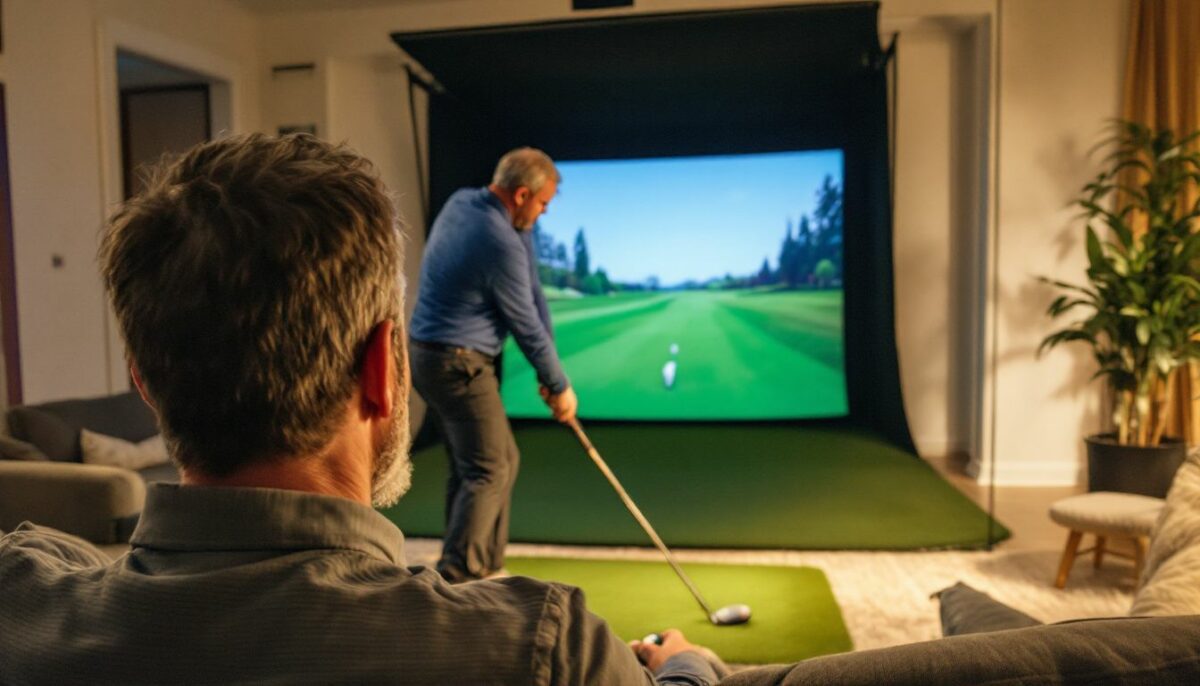
You can improve your swing at home with less space than you might expect. With a bit of room, a golf club, and the right tools like nets or simulators, you can work on your form indoors.
Swing drills for limited indoor space
Practicing your swing indoors can be productive even in a small area. You can still work on improving form, balance, and power.
- Stand near a wall to practice your backswing distance. Use the Wall Drill by swinging your golf club back until it gently taps the wall without hitting it hard. This helps control your backswing length.
- Face a mirror while doing slow swings for the Reflection Drill. Watch yourself to check swing positions and body alignment. This makes bad habits easy to spot.
- Grab a 7-iron and focus on making full swings with a balanced finish. Balance practice improves stability and reduces wobbly movements during outdoor play.
- Use a golf simulator or portable net if available in your space. Nets allow for safe full swings, while simulators give useful feedback on ball speed and distance control.
- Try slow-motion drills to fine-tune mechanics without needing room for full-speed swings. Break down each step of your swing for better precision.
- Hold your club upside down to focus on wrist control and grip pressure indoors. The lighter feel encourages smoother motion when practicing in small areas.
Next, let’s look at perfecting wedge play for better short-game results.
Using a net or simulator for full swings
A hitting net turns a backyard or garage into a personal driving range. Golfers can practice full swings without worrying about distance limits. Pair the net with a launch monitor like the SkyTrak, Rapsodo MLM, or Voice Caddie SC200 Plus to get instant feedback.
Data such as ball speed, spin rate, and carry distance helps you fine-tune performance.
Golf simulators take indoor practice up a notch. Software such as GSPro and E6 Connect lets players experience realistic courses while working on their game. This combination of tech and tools turns indoor golf into both training and entertainment.
A simulator also helps you track progress against your handicap over time.
Perfecting Your Wedge Play

Dial in your wedge game by sharpening your control and touch. Small adjustments can make a real difference, turning tricky shots into manageable ones.
Drills for distance control
Distance control is essential for a strong short game and reliable wedge play. Practicing this skill helps golfers improve precision and consistency on the course.
- Target One Spot
Hit 5 to 10 balls to the same target using a pitching wedge or short iron. Track how close each ball lands to keep your focus on improvement. Adjust your technique as needed after each round. - Leapfrog Drill
Place five markers at increasing distances, for example 10, 20, and 30 yards, indoors or outdoors. Aim to land the ball progressively farther at each marker without skipping any distance. - Random Targets
Rotate through four or five targets of varying lengths to add unpredictability. Use a launch monitor if available to measure accuracy while practicing. - Trajectory Experimentation
Work on hitting higher or lower shots with small adjustments in swing path or clubface angle. This prepares you for the tricky lies and wind conditions you may face on the course. - Speed Control Challenge
Use portable golf training aids like putting mats with distance markings. Work on controlling putt speed by trying to stop the ball precisely at different points along the mat.
These drills prepare golfers for practicing trajectory control next.
Practicing trajectory and spin control
Controlling ball trajectory and spin is key to shaping your shots. Practicing at home improves accuracy and helps you develop touch.
- Adjust the ball position during practice. Place it forward for higher shots or back for lower ones to control trajectory.
- Use a sand wedge for high, lofted shots. Pair it with softer swings to create more spin and land softer on target areas.
- Practice with an 8-iron for lower shots that stay under the wind. This trains you to produce the penetrating ball flight needed in tough conditions.
- Focus on your hand position at impact. Forward hands help generate lower shots, while neutral hands allow higher flights.
- Work on hitting down into the ball with a steeper angle of attack. This improves spin control, especially for chips and short approaches.
- For buried lies, deliver the club steeper than usual. A more lofted club like a lob wedge helps lift these balls out effectively.
- Use putting mats or carpets to simulate different lies indoors, training spin consistency across various surfaces.
- Keep your follow-through consistent during each drill to refine precision on both low and high trajectories.
Enhancing Your Short Game
Fine-tuning your short game at home can shave strokes off your score. With smart drills and focus, you can chip with real precision.
Chipping drills for precision
Chipping helps golfers improve their short-game skills. Practicing indoors makes it easier to focus on precision without worrying about big swings.
- Chip a ball into the air toward a coffee mug or similar target. This sharpens control and touch for smaller targets and forces you to adjust chip strength for accuracy.
- Use an indoor putting green and aim to chip balls directly into the hole. This improves hand-eye coordination and aim, even in limited spaces.
- Place objects like towels or small mats on the carpet as landing zones. The goal is to land your ball on each target, teaching distance control quickly.
- Use credit cards as markers on the floor instead of larger targets. Trying to hit such slim objects sharpens focus and precision.
- Set up cups at various distances on your carpet putting area. Aim your chip shots to land softly inside each one, building confidence with softer touches.
Maintaining turf interaction indoors
Practicing turf interaction indoors teaches better ball control. For buried balls, a steeper swing angle helps lift the ball cleanly. Balls sitting up nicely need a shallower approach to avoid digging too deep into indoor mats or practice surfaces.
Varying your lies during short-game practice improves adaptability. Try hitting from carpet, foam pads, or an indoor putting green to mimic real course conditions. Portable golf training aids can make this easier while building your skills at home.
Fitness and Strength Training for Golfers

Golfers need strong muscles and good balance to play well. Focus on building core strength and keeping your movements flexible for better control of your swing.
Core exercises to improve swing stability
Core strength is key for a stable, powerful golf swing. Stronger core muscles help with balance, control, and consistency.
- Plank holds build solid core endurance. Start with 20 seconds and gradually extend the duration over time.
- Rotational exercises like Russian twists improve torso flexibility. Use a light medicine ball or a golf club for added resistance.
- Side planks target the obliques for better rotation in the swing. Hold each side for 15 to 30 seconds while maintaining proper form.
- Dead bugs engage the lower abs and strengthen coordination. Lie on your back, lift the opposite arm and leg, then alternate sides smoothly.
- Bird dogs improve stability by targeting multiple muscle groups. Extend one arm forward and the opposite leg backward in a controlled manner.
- Pelvic tilts improve posture and reduce lower-back strain during swings. Lie flat, press your spine to the ground, and tilt your pelvis slightly upward.
- Cable wood chops simulate the swing motion while strengthening rotational power. If no cable machine is available, use resistance bands instead.
- Seated torso twists improve range of motion in limited space, using a lightweight object or just clasped hands.
Wrist control and flexibility exercises
A strong swing needs more than power. Flexibility and wrist control boost precision and consistency.
- Stretch your wrists daily to improve movement. Hold your arm straight and gently pull your fingers back for 15 seconds.
- Use a stress ball to strengthen grip muscles. Squeeze it 10 to 15 times per hand for better club control.
- Try wrist curls with light weights. Lift a dumbbell slowly using just your wrist for added strength.
- Practice forearm rotations with a golf club. Hold the club upright and twist it side to side 10 to 12 times.
- Do shoulder stretches to loosen the upper body. Tight shoulders can reduce swing fluidity.
- Include yoga or Pilates weekly to improve overall flexibility. These exercises ease tension in the muscles used during golf swings.
- Rotate your hips while standing tall to engage the core alongside wrist drills, supporting stability through the swing.
- Mimic holding a club while focusing on smooth wrist motion for realistic indoor practice anytime.
Mental and Visualization Practices

Golf is as much a mental game as a physical one. Train your mind to focus, block distractions, and picture the shot before swinging.
Building focus and confidence through mental exercises
Staying focused and confident is key to improving. Mental exercises help players sharpen their concentration and prepare for the course.
- Visualize success before every practice session. Close your eyes, picture the shot, and imagine the ball landing exactly where you want it. This builds a positive mindset.
- Reflect on previous rounds and identify mistakes. Think about shots that didn’t go as planned and consider how to adjust next time.
- Practice controlled breathing to stay calm under pressure. Breathe in for four seconds, hold for four, then exhale slowly for four seconds.
- Use affirmations to build confidence. Repeat phrases like “I trust my swing” or “I can make this putt” before taking a shot.
- Focus on one task at a time during indoor practice, such as a single putting or carpet drill, instead of multitasking.
- Set small goals for each session, such as improving trajectory control or a specific speed-training drill.
- Spend a few minutes each day meditating to clear your mind of distractions that may affect your play.
- Track progress by journaling after practice, using launch-monitor data or notes from your training aids to stay motivated.
Visualization techniques for shot planning
Close your eyes and see the shot. Picture the ball’s flight, its path, and where it will land. Many tour players use this mental technique to improve focus and plan their shots.
It helps create a clear goal before you touch the club.
Break it down step by step. Imagine your setup, swing motion, and follow-through as if it is happening in real time. Use indoor tools like a simulator to match your mental image with reality for sharper results.
Keep repeating until confidence builds naturally.
Using Technology for Practice Feedback
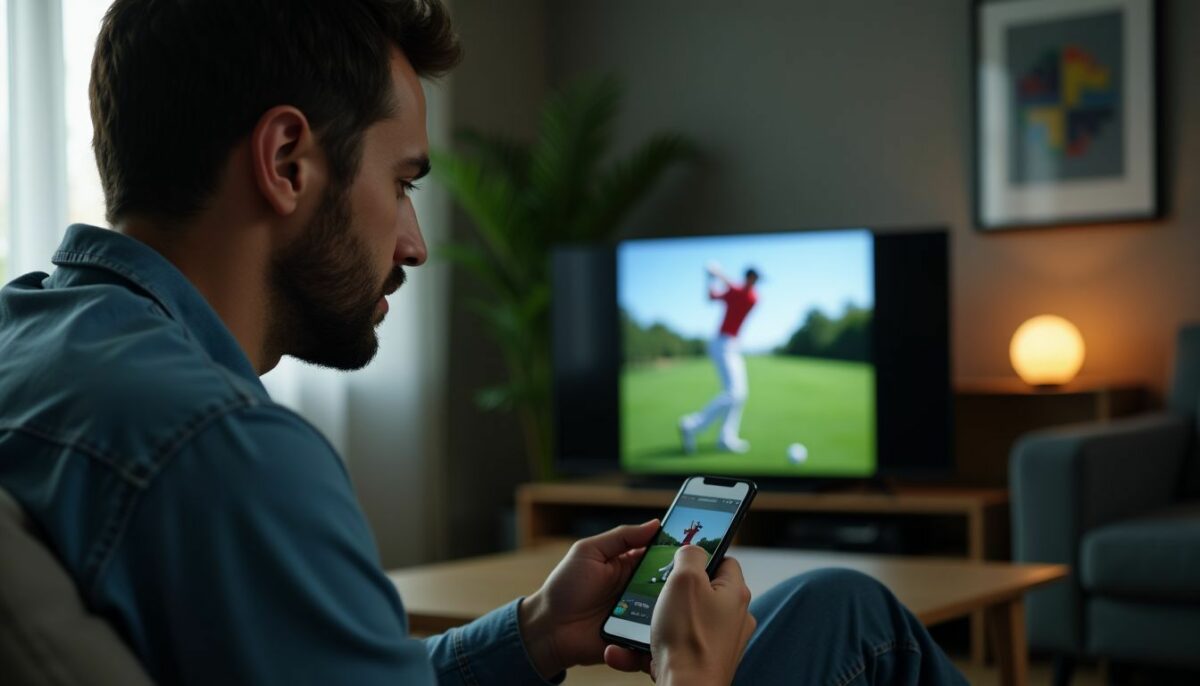
Technology can help you improve your game at home. Tools like swing analyzers and launch monitors provide clear data to refine your form and technique.
Benefits of launch monitors and swing analyzers
Launch monitors give golfers feedback on their swings and ball flight. They measure speed, distance, spin, and launch angle. This helps players fine-tune their shots without needing a course.
For example, you can adjust swing speed or check carry distance indoors with precision.
Swing analyzers focus on form and technique. They show details like club path, face angle, and tempo to highlight flaws in your movement. With these tools, small changes can lead to meaningful improvements.
Pairing them with portable golf training aids makes indoor practice sessions even more productive.
Recording and analyzing your practice sessions
A launch monitor helps, but recording your sessions adds a sharper edge. Use a smartphone or camera to capture swings, putts, and chips. This gives a clear view of flaws like grip tension or poor shoulder alignment during indoor practice.
Watching the playback helps you pinpoint mistakes fast. You might notice inconsistent wrist control in your putting drills or an off-balance stance while practicing wedge play on a mat.
Reviewing these videos can improve your accuracy and distance control with each session.
Off-Season Practice Tips

Cold weather doesn’t mean golf practice has to stop. Work on building strength, refining technique, and keeping your skills sharp indoors.
Creating a winter training plan
Set clear goals to keep improving during the off-season. A winter training plan maintains existing skills and builds new ones. Include daily indoor practice, focusing on areas like short game or distance control.
Use a putting mat or an indoor putting green for precise drills. Portable golf training aids can help with swing mechanics in tight spaces.
Add fitness exercises for strength and stability. Core workouts improve balance, while wrist flexibility supports control. Combine skill work with physical training to stay sharp even without a course nearby.
Stay consistent and track progress weekly for steady improvement through the colder months.
Staying motivated during off-season practice
A solid winter training plan creates focus, but staying motivated takes effort. Set goals that challenge yet excite you. Tracking progress keeps your energy high. Use a golf simulator or indoor putting green to mimic real play and stay sharp.
Break the monotony with fun drills or friendly competitions against yourself. Small rewards for hitting milestones can help keep spirits up. Treat off-season practice as an investment in your game, one that pays off on the course later.
Common Mistakes to Avoid in At-Home Practice
Skipping proper feedback tools can slow your progress. Launch monitors and swing analyzers give instant results that help you identify swing flaws. Practicing blindly risks building bad habits that stick over time.
Using a mirror is another simple way to check your positions during drills.
Picking the wrong space limits practice quality. A cramped area might tempt you to shorten your swing unnaturally or avoid full motion altogether. Always choose enough room for comfortable club movement, especially when practicing with nets or simulators.
Indoors, control distance by focusing on precise, repeatable movements rather than power alone.
Conclusion
Practicing golf at home is easier than it sounds. With the right tools, whether putting mats, nets, or even a carpet and a cup, real progress is within reach. Simple drills can sharpen your short game and swing without stepping outside.
Staying creative keeps practice engaging, rain or shine. Home training isn’t just a backup plan; it’s a genuine way to improve your game.
FAQs
1. How can I practice golf at home without a course?
You can use tools like putting mats, carpet putting setups, or an indoor putting green to work on your short game. Portable golf training aids and simple drills also help improve your swing and distance control indoors.
2. What are the best ways to improve my golf swing at home?
Practice with a golf simulator or portable training aids to refine your technique. Focus on trajectory control and speed training for better results.
3. Can I really get better at my short game with indoor practice?
Yes. Drills with putting mats or even practicing on carpet help boost accuracy and distance control in your short game.
4. Are there affordable options for indoor golf practice equipment?
Absolutely. Putting mats, small indoor greens, and budget-friendly portable aids are all effective choices that won’t break the bank.
5. Is it possible to track progress while practicing indoors?
Yes. Many tools like simulators and launch monitors provide detailed feedback on your swings and shots, so you can monitor improvement over time from home.