
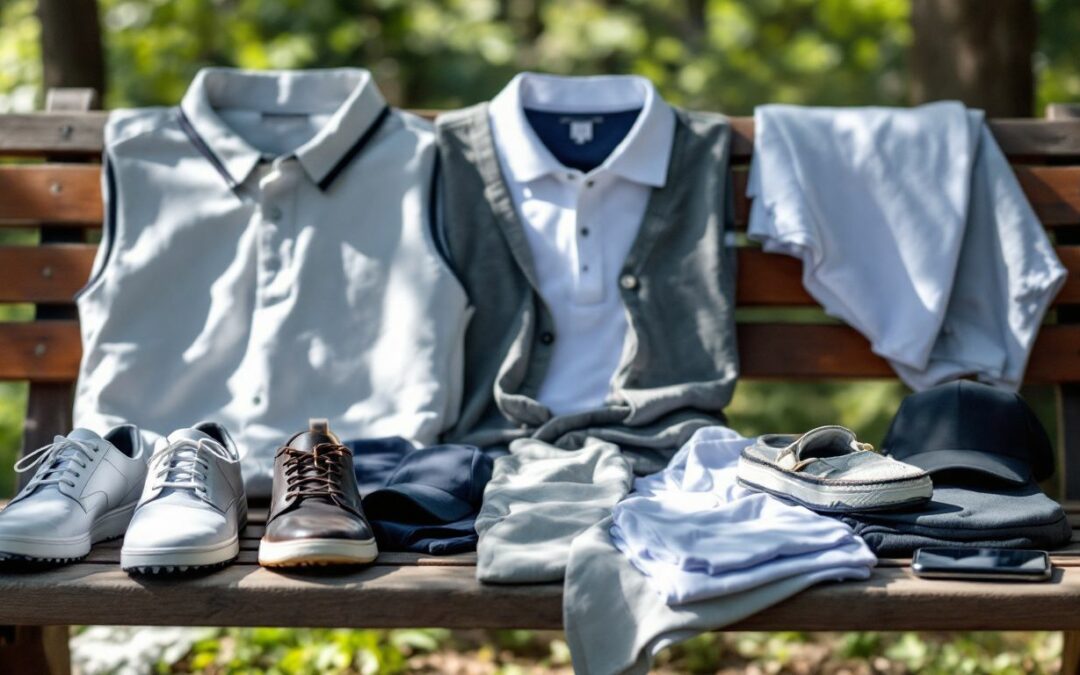
If you are wondering what to wear golfing, the short answer covers you almost everywhere: a collared polo shirt, tailored shorts or trousers with belt loops (not jeans), and golf shoes or clean athletic shoes with decent grip. Add a cap, and you will clear the dress code at the vast majority of public courses, resorts, and private clubs without a second glance from the pro shop.
Everything past that sentence is refinement. This guide walks through how dress codes actually differ between a municipal course and a private club, what never to wear, outfit specifics for men and women, how to dress for heat, rain, and cold, and a packing checklist if your first round is coming up.
Key Takeaways
- The safe default outfit is a collared polo, tailored shorts or trousers with belt loops, and golf or spikeless shoes — it passes nearly every dress code.
- Dress codes are set club by club, not by any governing body. Public courses tend to be relaxed, private clubs stricter — always check the club’s website or call the pro shop before you go.
- Denim, cargo shorts, gym shorts, t-shirts, jerseys, and swimwear are the items most commonly banned; metal spikes are unwelcome almost everywhere.
- Weather drives the rest: moisture-wicking fabrics and sun protection in heat, a waterproof jacket for rain, thin layers rather than one bulky coat for cold.
- You do not need a golf wardrobe for your first round — chinos, a plain collared shirt, and clean sneakers will get you on most courses.
The Safe Default Outfit
Golf has no universal rulebook for clothing — every club writes its own policy. But those policies overlap so heavily that one outfit works almost everywhere:
- Top: a collared polo shirt, short- or long-sleeved. Solid colors and small logos keep you safe at stricter clubs.
- Bottoms: tailored golf shorts (around knee length) or chino-style trousers with belt loops. No denim, no athletic shorts.
- Shoes: golf shoes — spikeless or soft-spike — or, at casual courses, clean athletic shoes with grip.
- Extras: a cap or visor worn forward, a glove, and sunglasses.
If you show up in that, the worst-case scenario at even a formal club is a minor tweak, like tucking your shirt in. The table below matches outfits to situations, and the sections that follow explain each piece.
Where You’re Playing, at a Glance
Dress expectations by situation — each row is unpacked in the sections below.
| Situation | Safe outfit | Leave at home |
|---|---|---|
| Driving range / Topgolf | Almost anything tidy — t-shirt and sneakers are fine at most ranges | Nothing specific; some club-attached ranges follow course rules |
| Municipal / public course | Polo or neat collarless shirt, tailored shorts or chinos, spikeless shoes or clean sneakers | Ripped jeans, gym shorts, tank tops, swimwear |
| Resort course | Golf shirt, tailored shorts or trousers, golf shoes | Denim, cargo shorts, sweatpants, t-shirts |
| Private club | Tucked-in collared shirt, tailored trousers or knee-length shorts, golf shoes; subdued colors | All of the above, plus backward caps and loud oversized logos |
| Hot climate (summer, Thailand, SE Asia) | Light-colored moisture-wicking polo, breathable shorts or skort, ventilated spikeless shoes, wide-brim hat | Cotton that soaks through, dark heavy fabrics |
Details on each tier, and what the bans actually cover, follow below.
Dress Codes by Course Type
The single most useful habit is checking the club’s own website before you play. Most courses publish their dress code on a policies or FAQ page, and thirty seconds of reading beats guessing. That said, the tiers below hold true often enough to plan around.
Municipal and Public Courses
Public courses are the most relaxed tier. A polo is the norm, but many munis accept any neat shirt, and clean athletic shoes are usually fine alongside golf shoes. Driving ranges and venues like Topgolf sit even further down the formality scale — regular casual clothes are standard there, which makes them comfortable places to start.
Do not assume “public” means “anything goes,” though. Colorado National Golf Club, a public course, requires a collared shirt at all times, bans t-shirts and tank tops even on the driving range, and prohibits denim from March through October. Policies genuinely vary in both directions — a few clubs, mostly rural or small-town, explicitly allow jeans in good repair. The only way to know is to look it up.
Resort Courses
Resort courses generally expect standard golf attire — a golf shirt with tailored shorts or trousers — while staying friendlier than private clubs about enforcement. The most common written exclusions at resorts are denim, cargo shorts, and sweats. If you packed the safe default outfit, you will not have a problem at virtually any resort, and the pro shop can sell you anything you forgot (at resort prices, so pack properly).
Private Clubs
Private clubs are the strictest tier and the most explicit about it. As one representative example, Huntington Country Club in New York specifies collared shirts with sleeves for men, permits slacks, golf shorts, or Bermuda shorts, and bans jeans, cargo pants and shorts, tank tops, sweatpants, and athletic shorts outright. Caps may not be worn backward and come off inside the clubhouse. Improperly dressed guests are asked to change before playing.
That pattern — tucked-in collared shirt, tailored bottoms, forward-facing cap, subdued look overall — is typical of the private tier. If you are playing as a member’s guest, ask your host what the club expects; it spares both of you an awkward conversation at the first tee.
What Not to Wear Golfing
The banned list is more consistent across clubs than the required list. These are the items that most often get golfers turned away:
- Jeans and denim of any kind — the most universal exclusion on golf courses.
- Cargo shorts and cargo pants — singled out by name in many club policies.
- Gym shorts, running shorts, and sweatpants — athletic wear reads as untidy under most codes.
- T-shirts, tank tops, and sports jerseys — no collar, and often big graphics, both of which codes exclude.
- Swimwear and cut-offs — banned virtually everywhere that bothers writing a policy.
- Metal spikes — nearly every course moved to soft spikes or spikeless years ago; leave metal cleats at home.
- Clothing with offensive text or oversized advertising — clubs commonly restrict both.
When in doubt, the test is simple: would this outfit look at home in an office with a casual dress policy? If yes, it will almost certainly pass on a golf course.
Golf Outfits for Men

Men’s golf clothing is about function as much as appearance — breathable pieces that move with the swing and still look presentable at the clubhouse.
Collared Polo Shirts
A collared polo, short- or long-sleeved, is the standard top on any course. Light colors reflect heat, and moisture-wicking synthetic fabrics keep sweat from becoming a distraction in warm months; cotton feels good in cooler, dry conditions but holds sweat once you heat up.
Fit matters more than brand. A polo should sit close enough to look neat but leave full room for the shoulder turn. Keep logos small and skip anything with large graphics — that is what separates a golf polo from a promotional shirt in the eyes of a dress code.
Trousers and Shorts
Golf trousers should be lightweight and slightly stretchable so nothing binds during the swing. Look for styles with belt loops — drawstring waistbands are a marker of athletic wear, which is exactly what codes exclude. Khaki, gray, tan, and navy are safe everywhere; white trousers work if you trust yourself around bunkers.
In warm weather, golf shorts should be well fitted and end around the top of the knee. Overly baggy cuts and three-quarter lengths read as untidy, and cargo pockets are a named exclusion at many clubs.
Shoes and Socks
Footwear completes the outfit, and it is the one place where genuine golf gear noticeably helps your game. Spikeless golf shoes are the most versatile pick for most players — comfortable enough to wear all day, with enough traction for dry and moderately damp courses. Soft-spike models grip better on slopes and wet turf.
Pair either with moisture-wicking synthetic socks rather than cotton. A round of golf is several miles of walking; cotton socks trap sweat and cause blisters, and it is the cheapest comfort upgrade in this whole guide.
Golf Outfits for Women
Women’s golf clothing has more variety than men’s, and dress codes reflect that — most clubs accept a wider range of tops and bottoms, with a few conventions worth knowing.
Tops
A collared polo is the safe default for women too, but the common club convention is more flexible: sleeveless tops are generally fine if they have a collar, and collarless tops are generally fine if they have sleeves — Huntington Country Club’s written policy, for example, permits exactly that combination. Sleeveless and collarless together is where stricter clubs draw the line.
Moisture-wicking fabrics matter as much for women as for men, and many golf tops now carry a UPF rating — worthwhile for four-plus hours in direct sun. REI’s guide to sun-protective clothing explains what those ratings actually mean.
Skorts, Shorts, Dresses, and Leggings
Skorts — a skirt front with built-in shorts — are the most popular women’s bottom in golf for a reason: they meet dress codes at nearly every club while allowing completely free movement. Golf dresses do the same job in one piece, and most are cut with stretch panels so the swing feels unhindered. Shorts follow the same guidance as men’s: tailored, roughly knee length or a bit above, with a proper waistband.
Leggings are the gray area. Many public courses now accept them, usually paired with a longer top or worn under a skort; traditional private clubs often still expect a skort, skirt, shorts, or trousers as the outer layer. If leggings are your plan, this is exactly the case where checking the club’s website first pays off.
Shoes
Women’s golf shoes are built on women-specific lasts, so they fit the heel and forefoot better than downsized men’s models. The spikeless-versus-soft-spike trade-off is the same: spikeless for comfort and versatility, soft spikes for grip on slopes and wet grass. Waterproof uppers are worth having anywhere with morning dew, and moisture-wicking socks apply here just as much as in the men’s section.
Accessories Worth Bringing
A few small items round out the outfit and do real work over four hours outdoors.
Hats, Caps, and Visors
A baseball-style cap is the default: it shades your face, manages sweat, and fits every dress code when worn forward. Visors do the same for the face while keeping the top of the head cool, and wide-brim or bucket hats give better sun coverage on exposed courses at the cost of some bulk.
Two etiquette points carry across most clubs: caps face forward, and headwear comes off indoors — club policies like Huntington’s state both in writing.
Golf Gloves
A glove improves grip and prevents blisters over a long round. Convention is one glove on the lead hand — left hand for right-handed players, and the reverse for lefties. Some golfers wear two in cold or wet conditions, which is practical even if less common.
Fit and material matter enough that we cover them separately in our golf glove guide; the short version is that thin cabretta leather feels best in dry conditions, while synthetic and hybrid gloves handle sweat and rain better and cost less. Carrying a spare lets you rotate when one gets damp.
Belts and Sunglasses
If your trousers or shorts have belt loops — and for dress-code purposes they should — wear a belt. A simple leather or woven belt that roughly matches your shoes finishes the outfit; a bulky casual belt undoes the tidy look everything else is building.
Sunglasses earn their place on any bright course. Polarized lenses cut glare off water and grass, which helps when tracking ball flight and reading greens, and lightweight frames that sit snug will not shift during the swing.
Dressing for the Weather
Once the dress code is satisfied, weather decides the rest of the outfit. The same collared-shirt-and-tailored-bottoms formula adapts to all of it.
Heat and Humidity
In hot weather, fabric choice does most of the work: light-colored, moisture-wicking synthetics keep you noticeably cooler than cotton, which soaks through and stays wet. Add a wide-brim hat or cap, sunglasses, and sunscreen on everything exposed — a golf round is four to five hours of continuous sun.
If you are playing somewhere genuinely tropical, the formula intensifies. On a golf trip to Thailand or elsewhere in Southeast Asia, experienced visitors pack two gloves and sometimes a spare shirt to change at the turn, because everything is damp by the ninth hole — and the dress codes at Thai clubs are the same collared-shirt standard you would meet at home. Our guide to playing in hot weather (linked below) covers the on-course side: hydration, pacing, and tee-time timing.
Rain and Wind
A packable waterproof jacket is the one weather item worth keeping in your bag permanently. Golf-specific rain jackets are cut with stretch and quiet fabric so they do not restrict or rustle during the swing, but any breathable waterproof shell beats getting soaked. Add a towel clipped under your umbrella, a spare glove (wet leather gloves lose grip fast), and trousers that dry quickly. Windbreakers handle the days that are blustery but dry — wind chill on an exposed course is real even in mild seasons.
Cold Weather
Cold-weather golf is a layering problem: several thin layers beat one bulky coat, because you need a free shoulder turn on every swing. A typical stack is a base layer, a long-sleeve polo, and a sweater or quilted vest, with a windproof outer layer on top if needed. Thermal socks and a warm hat cover the extremities, and winter gloves between shots keep your hands functional. Swap shorts for lined or standard trousers once temperatures drop — details on that threshold are in the beginner section below.
First-Round Packing Checklist
If your first round is coming up, here is everything worth having, in one list:
- Collared polo shirt — or a neat substitute (see the next section).
- Tailored shorts or chinos with a belt.
- Golf shoes or clean grippy sneakers — plus synthetic, not cotton, socks.
- Cap or visor and sunglasses.
- Glove — one for your lead hand; a spare if it is hot or wet.
- Sunscreen and water — four-plus hours outside.
- Light rain jacket or windbreaker if the forecast is unsettled.
- A quick look at the course’s website the night before — dress code, and whether they rent clubs if you need them.
What to Wear If You Don’t Own Golf Clothes Yet
You don’t need a full golf wardrobe to play your first round. If you’re not ready to invest in golf-specific pieces, several everyday items can meet most dress codes and get you on the course looking the part.
- Work trousers or chinos look sharp and satisfy the dress code, as long as they aren’t jeans.
- A buttoned-down work shirt stands in for a polo when you skip large or flashy logos.
- A plain T-shirt layered under a sweater works for colder rounds—keep colours subtle to stay within the standard golf look.
- Clean sneakers or trainers with good grip can pass for a beginner game if you don’t own golf shoes yet.
- Borrowing from friends who play is an easy option—many golfers keep spare gear they’re happy to lend.
- Thrift stores and discount retailers often carry polos, slacks, and skorts that fit golf fashion for a fraction of the price.
- Pro shop rentals are a last resort—handy in a pinch, though they usually cost more than the options above.
A Note on Cold-Weather Bottoms
Shorts and skorts are fine until the temperature drops. Once it falls below roughly 50°F, swap them for lined golf trousers—the extra insulation keeps you comfortable and mobile without breaking the dress code.
FAQs
1. What should you wear golfing for the first time?
A collared polo, tailored shorts or chinos with a belt, and clean athletic or golf shoes. That passes the dress code at almost any course a beginner would play. If you do not own a polo, a neat buttoned shirt works at most public courses.
2. Can you wear jeans to golf?
Usually not. Denim is the most commonly banned item in golf dress codes, including at many public courses. A small number of casual clubs allow jeans in good repair, but never assume — check the course’s website, and default to chinos if you are unsure.
3. Can you wear leggings on a golf course?
Increasingly yes at public courses, especially under a skort or with a longer top. Traditional and private clubs often still expect a skort, skirt, shorts, or trousers as the outer layer. Policies vary widely, so check before you go.
4. Do you need golf shoes, or are sneakers fine?
For your first rounds at a public course, clean sneakers with decent grip are usually acceptable. Golf shoes become worth it quickly — spikeless or soft-spike soles grip slopes and damp grass in a way flat soles cannot. Metal spikes are banned almost everywhere.
5. What do you wear golfing in hot weather?
A light-colored moisture-wicking polo, breathable tailored shorts or a skort, ventilated spikeless shoes, a wide-brim hat or cap, and sunscreen. In tropical heat, bring a spare glove and consider a spare shirt for the back nine.
6. Are t-shirts ever OK on a golf course?
At driving ranges and Topgolf-style venues, yes. On actual courses, most dress codes require a collar (or, for women, sleeves on a collarless top), and some public courses ban t-shirts outright — so treat a polo as the default and a t-shirt as the exception you verify first.